Understand your team's Lead Time for Changes
Learn how to navigate your organization's Lead Time for Changes data and how you can take action to mitigate risk
Trend
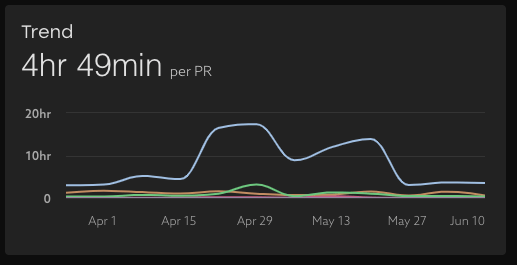
Learn about your organization by analyzing your Lead Time for Changes trend over time. With this view, you can easily see where delays happen and take action. Each line represents a stage in the process. The 2023 State of Devops Report states that about 18% of teams typically deploy changes to production in less than 1 day, and 31% of teams between 1 day and 1 week.

Tip: encourage your developers to submit smaller PRs more often. This will keep everyone in the practice of merging frequently and will take less time to review.
Median Time by Phase
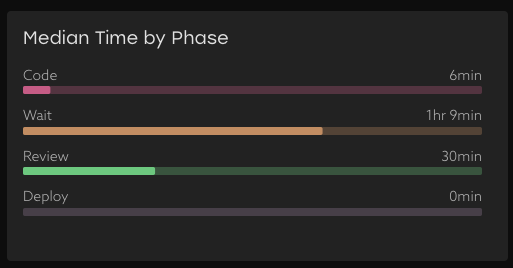
See exactly how much time is allocated to each phase for the most recent week of the period. Compare this to your trends over time to see how you're tracking.
Breakdown Table
Drill down further by using the breakdown table. This view lets you dig in further to understand which teams or working areas might need support by pivoting on various people properties like Report Group or Role, or by Repository. A "null" value means that team didn't have any PRs for that time period.
This table provides helpful context to understand the Lead Time for Changes Trends, like Delayed PRs (% of PRs that took longer than expected from opened to merged based on complexity), and Complex PRs (% of PRs that are estimated to be complex to review).
Related Articles
Lead Time for Changes
How does Uplevel define Lead Time for Changes? The DORA metric Lead Time for Changes is measured as the median duration of time from first commit until the Pull Request is deployed to a production environment using CI/CD Data. This differs from Cycle ...Epic Lead Time
Understand the bottlenecks in your planning process by looking at your Epic Lead Time phases Overview Epic Lead Time is defined as the median epic duration, which is calculated as the difference in time from when the epic is created, through to when ...How to decrease your team's unallocated time
Tips and best practices to get a more complete picture of your organization's investments in Time Allocation Uplevel's Time Allocation metric combines signals from calendar, chat, project tracking (Jira) and version control systems (git) to estimate ...PR Cycle Time
Understand the flow of a PR from commit to merge PR Cycle time measures the median time your Pull Requests are in three different stages: Dev, Waiting, and Review. Phase 1: Dev The first phase looks at how long the particular PR was in development. ...How to Understand Your Organization's Top-Level Investments
Keeping Jira data tagged consistently is difficult at all levels of an organization. Some teams are on company-managed boards with required custom fields, while other teams use team-managed boards where those same rules don't apply. Some teams are on ...